From EVs to Androids: XPENG’s IRON Robot Marks a New Era
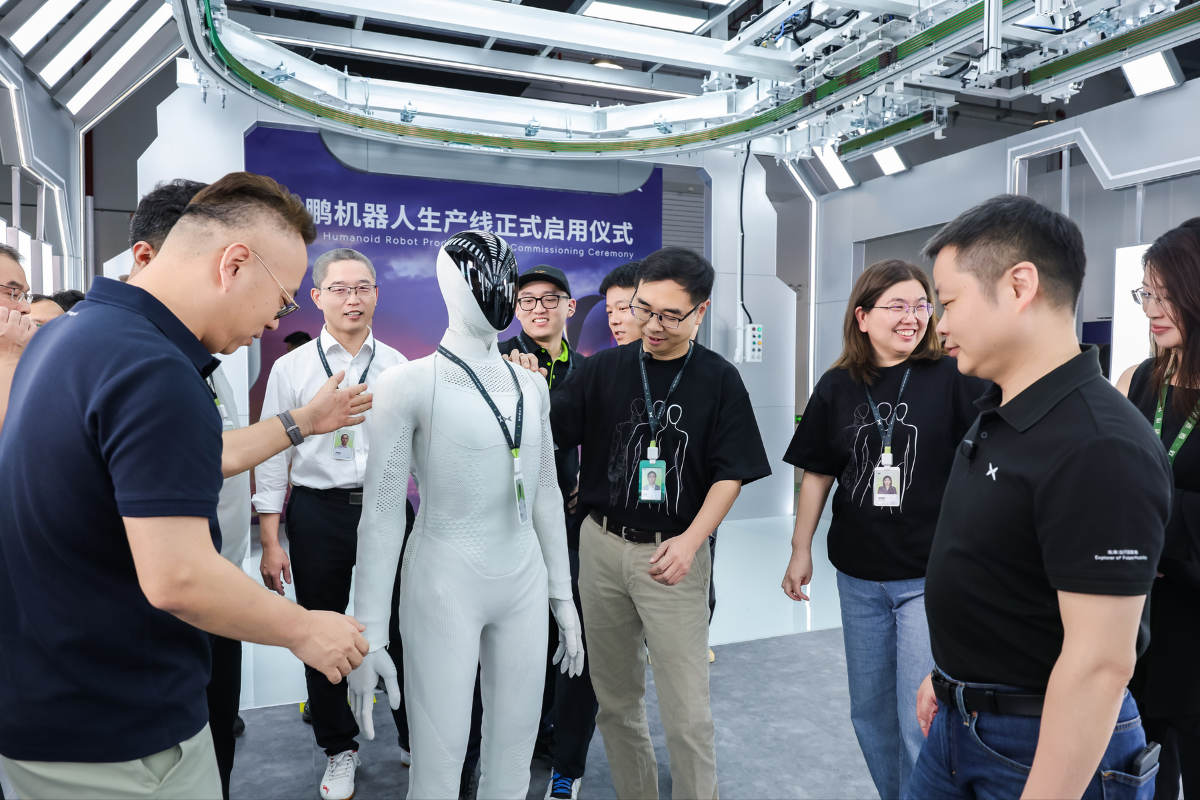
XPENG has officially crossed the line from building electric cars to building electric humanoids. The company commissioned its first production line dedicated to humanoid robots, marking a major shift in its business.
The first next-generation IRON robot to roll off that line walked away under its own power. XPENG is calling it a symbolic moment — proof that its “Physical AI” ambitions are no longer just a lab experiment.
XPENG’s Robot Factory Signals a Manufacturing Breakthrough
According to XPENG, the new facility is the world’s first automated production line built specifically for advanced humanoid robots. It borrows automotive-grade quality control systems originally developed for the company’s electric vehicle lines.
Those systems are now applied to the far trickier task of assembling a walking, talking machine. More than 80% of the plant’s core processes are automated, the company said.
XPENG says it built the system to scale quickly while keeping quality consistent. That balance is critical as the company moves from small-batch prototypes to mass output.
Chairman and CEO He Xiaopeng said the production line was built without a blueprint to follow. “Today’s step is small, but XPENG is building the production lines for an entirely new product category,” he said.
He added that the company plans to push for faster production rhythms and greater scale in the months ahead. The goal, he said, is to lead the robot manufacturing industry both in China and worldwide.
The next-generation IRON itself is a showcase of that engineering push. According to XPENG, it runs on 76 degrees of freedom across its body and 21 in each hand.
The robot is wrapped in a flexible lattice structure designed for both safety and looks, the company said. It reportedly processes information through three in-house AI Turing chips capable of up to 2,250 TOPS of combined computing power.
Why XPENG’s Robot Bet Could Outshine Its Car Business
XPENG isn’t treating IRON as a side project. The company expects gross margins on its humanoid robots to run significantly higher than those on its electric vehicles.
That expectation ties back to the technical difficulty and limited global supply of advanced humanoid machines. Few companies can currently match the scale XPENG says it’s targeting.
That confidence has already attracted serious money, according to the company. In late August, XPENG’s robotics unit said it raised more than $900 million from multiple investors at a post-money valuation above $6.3 billion.
XPENG describes it as the largest single-round private funding deal in China’s embodied AI sector to date. That claim, however, comes from the company itself and has not been independently verified.
Mass production of IRON is targeted for the end of 2026. Early units will be deployed at XPENG’s own stores and campuses before a wider rollout.
Broader commercial delivery in China and overseas markets is scheduled for 2027. He Xiaopeng has called robotics a potential “second growth engine” alongside the company’s core vehicle business.
The timing lines up with XPENG’s broader global push. The company is set to officially launch in the Philippines on September 25, 2026.
That event will debut the X9 flagship seven-seater and the L03 AI SUV coupé. It’s part of a strategy that now treats cars, robots and international expansion as three connected pillars, not separate bets.