Less Than 1% of Togo’s Farmers Have Irrigation. A $120 Million Deal Just Changed That
Sixty percent of Togo’s workforce farms the land. Only 20% of what they grow ever reaches a market. A EUR 108.3 million financing facility just arrived to fix that — and the numbers behind it are as striking as the deal itself.
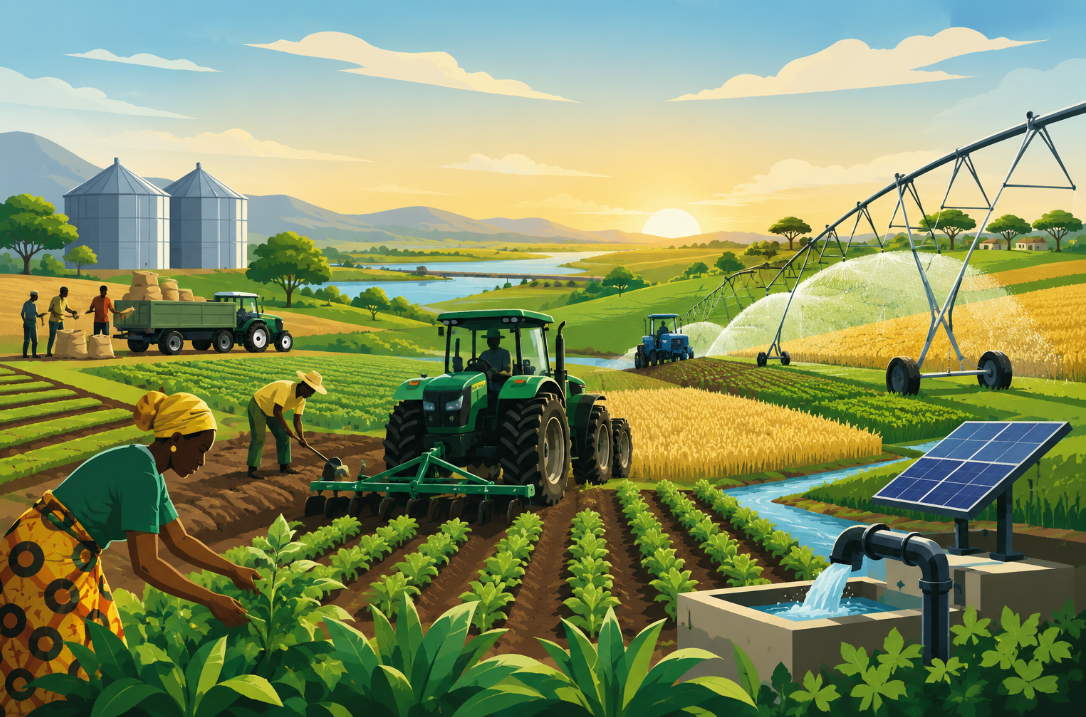
Here is a number worth sitting with: less than 1% of agricultural households in Togo have access to irrigation. In a country where farming employs nearly two-thirds of the population and accounts for roughly 40% of GDP, that figure is not just a statistic — it is the entire explanation for why one of Africa’s most agriculturally active nations has never fully fed itself, let alone its neighbors. That is about to change. Africa Finance Corporation (AFC) has arranged a EUR 108.3 million sovereign-backed financing facility for the Government of Togo, deploying 2,126 tractors, 930 irrigation units, 1,020 units of seeding and harvesting equipment, and 95 water supply systems across a country that has been farming largely by hand for generations. This is not an incremental upgrade. It is a structural reset.
The Shocking Gap Between Togo’s Farm Potential and Farm Reality
The case for this investment is built on a set of statistics that are almost difficult to believe. Only 37% of Togolese agricultural households use fertilizer. Only 8% use improved seeds. And while agriculture drives nearly half the national economy, just one in five units of food produced actually makes it to market. The rest — grown by hand, without mechanization, without irrigation, without modern inputs — is consumed locally or lost entirely.
This is the productivity trap that AFC’s 10-year financing facility, structured under Togo’s national agricultural transformation strategy known as ProMAT — the Programme de Modernisation de l’Agriculture Togolaise — is designed to break. By directly addressing the mechanization and irrigation gaps that have constrained Togolese farmers for decades, the program aims to increase yields, expand commercialization, improve market access, and support job creation at scale. The machinery alone — more than 2,100 tractor and trailer sets, nearly 1,000 irrigation units, and close to 100 water supply systems — represents an injection of productive infrastructure that simply did not exist in Togo’s agricultural economy before this deal.
“Food security has become an increasingly urgent priority for African countries as global supply chains become more volatile and climate-related risks intensify,” said Samaila Zubairu, President and CEO of AFC. “This financing demonstrates AFC’s ability to deliver sovereign financing solutions that unlock productivity, strengthen food systems and support long-term economic resilience by supporting Togo’s agricultural modernisation agenda.”
Why AFC’s Togo Bet Is About Far More Than One Country
AFC’s inaugural sovereign investment in Togo is significant on its own terms. But the broader context makes it even more consequential. The facility arrives as global supply chain disruptions, climate-related shocks, and surging agricultural input costs are forcing African governments to confront a hard truth: food security cannot be outsourced. The continent must produce more of what it eats — and sell more of what it produces.
AFC is not new to sovereign financing at scale. The corporation has arranged approximately $2.5 billion in facilities for sovereign borrowers across Nigeria, Angola, Côte d’Ivoire, and Egypt, supporting critical national institutions and infrastructure programs — from the Egyptian General Petroleum Corporation to the General Authority for Supply Commodities. The Togo deal adds a new dimension to that track record, one focused not on energy or logistics but on the agricultural backbone that underpins economic stability across the continent.
The timing is deliberate. As rapid population growth accelerates demand for food across sub-Saharan Africa, the window for building domestic production capacity is narrowing. AFC’s bet on Togo is a bet that the continent does not have to remain a net importer of food — that with the right financing, the right equipment, and the right national strategy, countries like Togo can move from subsistence to surplus. With more than 2,000 tractors and nearly 1,000 irrigation units about to hit Togolese farmland, that shift is no longer theoretical. It has already begun.