The World Cup’s Most Unexpected Table Is Here—AI Reveals Which Nations Can Actually Sing
As the 2026 FIFA World Cup barrels through its final group-stage matchdays with the Round of 32 looming, a different kind of leaderboard is going viral — and it has nothing to do with goals, points, or goal difference. A new analysis by ActionNetwork.com has ranked all 48 participating nations based on how in tune their supporters and players sang their national anthems, using AI-powered vocal isolation and pitch detection software to measure singing quality across the tournament.
Forget the official standings — this is the World Cup’s vocal power ranking, and it’s reshuffling bragging rights from Tokyo to Curaçao.

How AI Scored World Cup National Anthems
The methodology behind the viral “singing table” is surprisingly rigorous. ActionNetwork.com analyzed anthem performances from all 48 nations using vocal isolation and pitch detection software to separate supporters’ and players’ singing from stadium noise and broadcasts.
Each nation received a composite score between 0 and 1, with 1 representing the highest possible performance. The rankings were calculated using four weighted components: pitch accuracy (40%), measuring how precisely supporters and players hit the correct notes; commitment (40%), reflecting how much of the anthem was actively sung rather than left silent; melodic richness (10%), assessing whether the singing featured genuine melodic movement instead of a monotone delivery; and pitch stability (10%), evaluating how steadily notes were held throughout the performance.
Based on their overall scores, nations were grouped into four statistical tiers, ranging from Tier 1, the tournament’s most in-tune performers, to Tier 4, which contained the lowest-scoring anthem performances.
Which World Cup Nations Are Topping the Chart?
Japan topped the rankings as the most in-tune nation at the 2026 FIFA World Cup, posting a composite score of 0.784. Curaçao followed in second place with 0.670, while Iran finished third on 0.660.
Iran also led the entire field in pitch accuracy at 92.9%, meaning its supporters and players hit the correct notes more consistently than any other nation in the tournament.
The United States and South Africa shared the highest commitment rate, with both nations singing 87% of their respective anthems — the best mark among all 48 countries. Meanwhile, Japan, Curaçao, Haiti, Cape Verde, Algeria, Qatar, and Portugal all achieved a perfect pitch stability score of 1.00, demonstrating exceptional consistency in holding notes throughout their anthem performances.
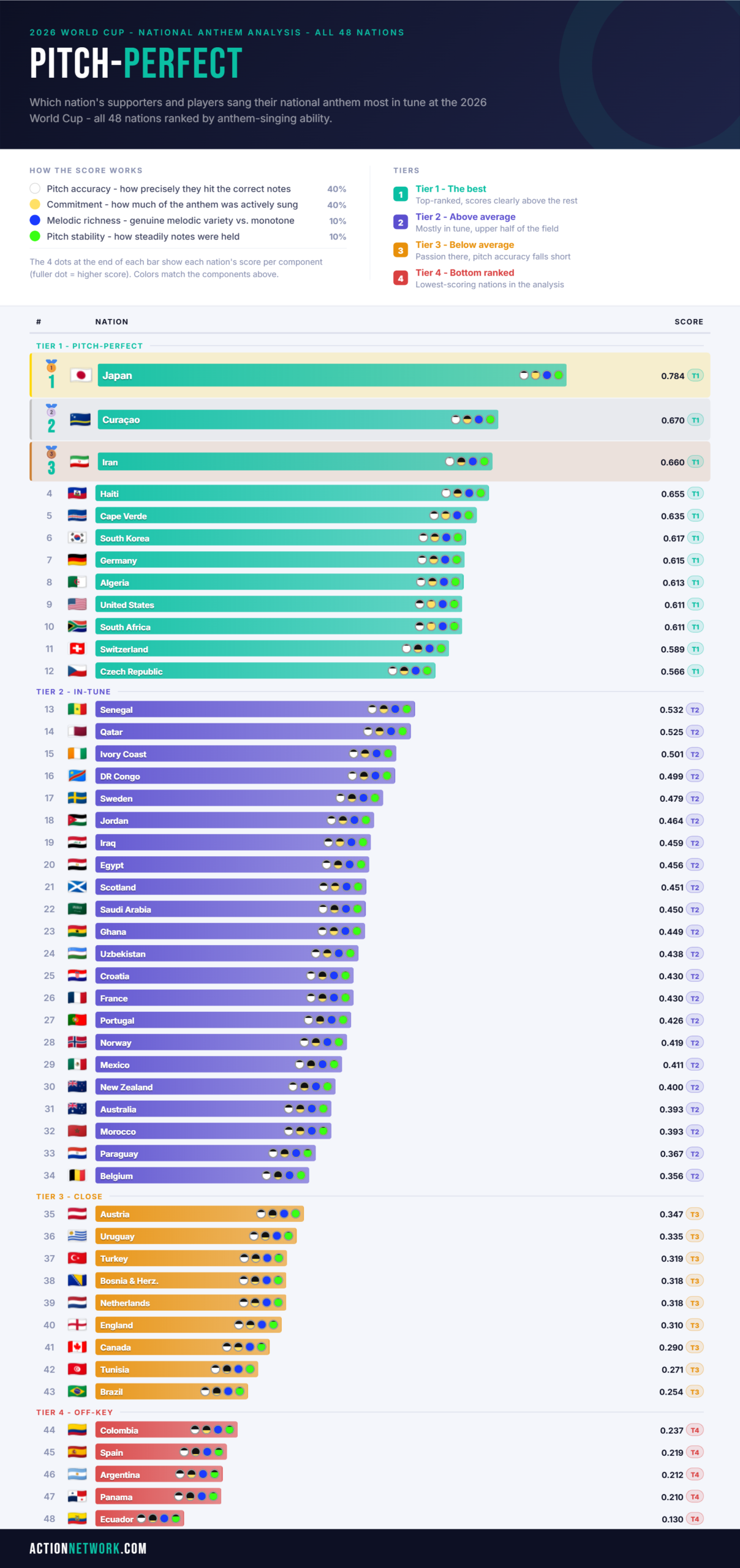
One category produced a universal result: every nation received the maximum score for melodic richness, confirming that all 48 fan bases displayed genuine melodic variation rather than simply chanting in a monotone.
At the other end of the rankings, Ecuador finished last with a composite score of 0.130, followed by Panama (0.210) and Argentina (0.212).
Colombia recorded the tournament’s lowest pitch accuracy at 52.7%, making its supporters and players the least precise at hitting the correct notes. Tunisia posted the weakest commitment rate at just 19%, meaning fewer than one-fifth of its anthem was actively sung. Argentina also ranked last in pitch stability with a score of 0.73, while Spain followed closely behind at 0.76, indicating the greatest difficulty in sustaining notes consistently.
As the tournament shifts into the knockout rounds, the ActionNetwork.com rankings offer a lighthearted look at another form of World Cup competition — one measured not by goals, but by national pride and musical performance.
Keep reading below for more detail on the top- and bottom-ranked nations. The full ranking of all 48 nations — including an interactive graphic available in multiple languages — can be found here.
Data courtesy of ActionNetwork.com.