Why Even Intelligent Leaders Can Fail If They Don’t Make Time to Think
Brainpower alone will not save a business leader. Some less intelligent individuals can defeat many intellectuals who tend to be lazy by applying discipline to the results of their mental energy.
Leaders who skip that thinking risk a wrong strategy, a failing initiative or a merger that fails to create value. Yet most managers and executives spend only a little of their time on it.
John Sterman, the Jay W. Forrester Professor of Management at MIT Sloan, said in an MIT Sloan Executive Education LinkedIn Live webinar that the problem is not intelligence or effort. It is how leaders think.
Intelligence Is Not Enough
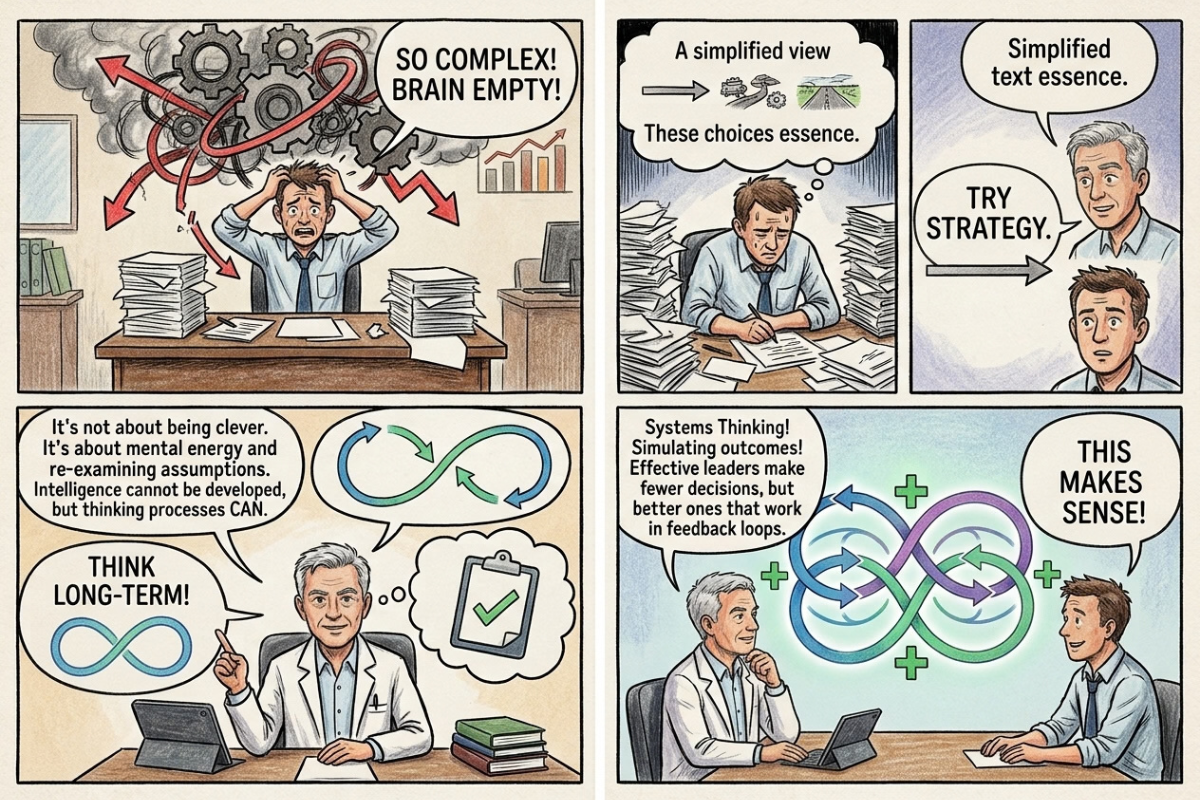
Mental energy, or the drive to think harder than the average executive, is the fundamental quality of effective leadership. A leader is expected not to be mentally lazy. Ideas and imagination come from continued mental activity, not just an unusual spark of genius.
According to psychologists, intelligence cannot be controlled or developed, but the use of the thinking process can. Profound intelligence paired with a great deal of applied mental energy is a splendid combination.
Effective business leaders constantly think, especially before taking action. Restive and discontented leaders, by contrast, are known to be physically lazy and appear to use mental energy to save physical energy.
Setting aside considerable time to contemplate ideas and solve problems takes mental discipline. It is an ability that can be developed through determination.
The Cost of Crowded Schedules
Day-to-day details leave little room for creative thinking. Managers and executives are loaded with them, which limits the time left for generating ideas and solving problems.
Some companies make this worse by deliberately limiting the number of executives and support staff. They wrongly assume there are savings in keeping personnel loaded with regular duties.
Other executives hesitate to delegate because they believe doing tasks personally proves they are worthy employees. Executives who do not set aside quality time for creative thinking are, in effect, mentally lazy.
How Success Breeds Blind Spots
Many failed decisions are made by highly capable people. A company commits to the wrong plan despite clear warning signs, or a leadership team keeps investing in a failing initiative after the evidence turns negative.
These decisions rarely feel wrong when they are made. They feel reasonable and logical, because the problem is not bad reasoning but good reasoning built on unexamined assumptions.
Experience improves pattern recognition, speed and confidence, but it also creates hidden rigidity. The more often a model has worked, the harder it becomes to recognize when it no longer applies.
Soccer manager José Mourinho offers an example of how consistent success builds belief in a model. His disciplined, defensively structured approach won league titles across multiple countries and Champions League trophies with teams not considered favorites.
Such belief can become near-unshakable. For business leaders, the lesson is that every model works best under certain conditions, and prolonged success can reduce the willingness to reexamine them.
Organizations amplify the effect. Assumptions become embedded in meetings, priorities, metrics and internal narratives, so firms stop testing them and start defending them when growth, profits or market dominance seem to confirm the model.
Confidence adds to the risk. Teams want clarity and investors want conviction, so cultures reward decisiveness over hesitation. Leaders who tie their identity to being right begin treating new information as a threat rather than feedback.
What Hurried Decisions Miss
Capable executives can still solve problems in ways the system cannot sustain. Most organizations still follow a linear model: define the problem, analyze options, choose and execute. In complex environments, however, decisions unfold through feedback loops.
Policy resistance occurs when solutions look effective at first but undermine themselves. Examples include road expansion that often brings more traffic, healthcare cost controls that can raise spending, and strategic mergers that frequently fail to create value.
Leaders also overlook what sits beneath the surface. Delays, indirect effects and reinforcing feedback loops quietly shape outcomes, so tighter healthcare approvals may lower unit costs in the short term but can delay care and ultimately raise overall demand.
Decisions do not have “side effects.” Every decision produces multiple effects, and a so-called side effect is simply an outcome outside the boundaries of a leader’s thinking.
Experience can mislead as well. When feedback is delayed or distorted, early success reinforces flawed strategies, and organizations double down just as the system begins to push back.
Making Time to Think
Strong leaders deliberately introduce friction into decision-making. They invite disagreement, stress-test assumptions and seek information that contradicts their preferred conclusion. Weak cultures optimize for agreement, while strong ones optimize for accuracy.
They keep asking whether their advantage is temporary, which assumptions are treated as permanent, and what evidence would show the model no longer fits reality. That habit creates cognitive flexibility, one of a leader’s most important competitive advantages.
Developing systems thinking takes simulation, experimentation and structured reflection that make system behavior visible. The leaders who succeed take time to understand the systems they shape and resist quick fixes.
Effective leadership is not about making more decisions but about making fewer that actually work. Leaders who protect time to think are better placed to question a model before reality forces the issue.

- Why Even Intelligent Leaders Can Fail If They Don’t Make Time to Think - October 4, 2026
- How Bosses Should Discipline Employees Without Creating Resentment or Conflict - October 4, 2026
- HBO’s Exit From Cignal Exposes Cable TV’s Slow Collapse in the Philippines - September 4, 2026